BIBLIOGRAPHY

These are some of the readings that have helped me to try to understand what is happening with our democracies. Are our democracies in danger? What use do those who get into power make of democracies? How do they get into power? Are the voters really the problem, as Jason Brennan points out?
I recommend reading all these books; they are the best vaccine against the barbarities that we have to hear in our "democratic" parliaments. The disqualification to which the political "leaders" have accustomed us is turning a more or less cohesive society into a society-of-silos. The debate no longer exists and now there is a low-class confrontation that uses vulgar vocabulary, lies and exaggerations, but never a look into the future to work towards a better, prosperous, educated and free society.

AGAINST DEMOCRACY
Jason Brennan reminds us the weaknesses of the current democratic systems by emphasizing the main problem: voters (Hobbits, Hooligans and Vulcans). Against Democracy is a controversial work that aims at making us think beyond acceptable behaviors and what is considered politically correct. Demolishing and sensible criticism of the current democracies.
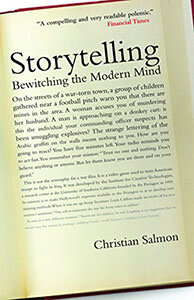
Storytelling:
Bewitching the Modern Mind
Christian Salmon reveals how a good story is the new weapon of mass distraction that politicians use to sell their messages to the public. Because it is not about the debate of ideas anymore, but the control of emotions. Very well-articulated lies, the construction of new scenarios where political adversaries become enemies. From the control of public opinion to the control of public emotion.
.

THE REVOLT OF THE MASSES
Ortega shows us his reality and 90 years later we can verify how little reality has changed. For Ortega, the mass-man is a group of individuals who have deindividualized and have ceased to be free and thinking human units to get dissolved in a community that thinks and acts for them, more by conditioned reflexes (emotions, instincts, passions) than reasons.

THE LIFE AND TIMES OF LIBERAL DEMOCRACY
This book was written in the XX century, talks about XIX century thinkers and is being read nowadays. Macpherson brings light to the idea of democracy. More than discovering what Betham or Stuart Mill thought, I find very interesting to get to know what were the questions that they asked themselves and the issues that concerned them. I have the feeling that these big questions are not being asked nowadays. Democracy is used, but it is not thought nor questioned, and even less those who make a living from it.
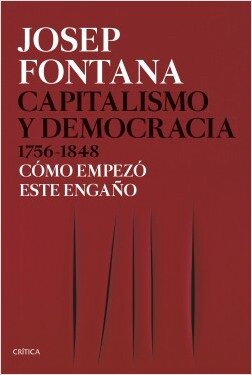
CAPITALISM AND DEMOCRACY, 1756-1848
After reading the title, my imagination promised me more and I thought I would have quick access to extreme doses of criticism to democracy and capitalism. I was wrong, it is better than this. It is a chronological and slow-paced story of the awakening of international trade, the first agricultural revolutions, the bourgeoisie and the first democracies.
Fontana explains the story in such a way that the bourgeoisie is not seen as a promoter of freedoms, progress and democracy but as a main actor who reacted to what was coming for them. Everything the bourgeoisie did was in self-defense.
Like Piketty, he plays part of Victorian society with Jean Austen's novels. Fontana tells us about one of the first large-scale robberies that was committed with the Enclouser Acts, through the poetry of John Clare: “there was a time my bit of ground
made freemen of the slave… till vile enclosure came and made a parish slave of me”.

THE PEOPLE VS. DEMOCRACY
Together with “How Democracies Die”, this is an ideal book to start reconsidering what this is all about. Yascha Mounk invites us to look through statistics and reflections to take the end of liberal democracy very seriously, just as it was before stridency and systematic lies entered into our parliaments.
There are political parties that win elections by threatening their political adversaries. Threatening to shut down the media and generating hatred against minorities. The serious thing is that they do it because there are millions of free citizens who are delighted with this ideology. Especially revealing is chapter 3.

FEAR: HISTORY AND POLITICAL USE OF AN EMOTION
Boucheron and Robin analyse the different political uses of this particular emotion that governs, to a lesser or a greater extent, part of life and humanity decisions. A journey throughout history and the political thinking of fear to understand one of the most effective weapons to convince, govern and control.

HOW DEMOCRACIES DIE
Steven Levitsky and Daniel Zibblat have been studying for years the mutation that some democracies have suffered. They have identified 4 tics of authoritarian leaders.
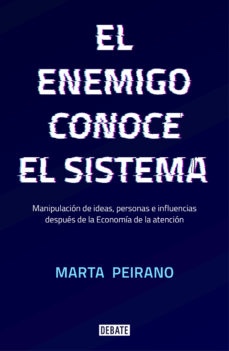
THE ENEMY UNDERSTANDS THE SYSTEM
Facebook or Google know more about us than the police. It is information that we have given them in exchange for entertainment or other information. Marta Peirano tells us about the control and destruction of democratic processes through the new Soma, Internet.
The information that we voluntarily or involuntarily give to the different social networks is creating information superpowers. Entities that would be the bad guy in a James Bond movie are earning money and power with what they know about us. But can this information go against us? It is already against us, not as individuals but as society. For instance, YouTube’s “smart” algorithms radicalize our political opinions by suggesting similar but more “shocking” videos, regardless of their veracity.

POLITICS AS A VOCATION
Reading Weber’s work is like looking at a mirror that is 50 light years away and seeing that everything remains the same. He published the lecture in the summer of 1919... That’s a hundred years ago! According to Max Weber, the three most important qualities that a politician should possess are passion, sense of responsibility and measure. When you read about that you get into a political depression and it makes you want to paint a painting or bury a hope.
I’m interested in two main things about these thoughts. On the one hand, I’m interested in his discourse of the State as a monopoly of legitimate physical violence. And on the other hand, and I quote textually: “…quite unprincipled parties oppose one another; they are purely organizations of job hunters drafting their changing platforms according to the chances of vote-grabbing, changing their colors to a degree which, despite all analogies, is not yet to be found elsewhere”. Does it ring a bell?

21 LESSONS FOR THE 21ST CENTURY
Harari has become living classic, he is like Murakami or Auster.

WHY NATIONS FAIL
Essential book to look at the history of humanity from a different perspective. It tries to explain the reasons why some groups of humans live in prosperous societies full of opportunities and others do not. Regardless of resources, climate or religions, the common denominator of failure is corruption and narrow-mindedness of those authorized to rule a country.
Daron Acemoglu and James Robinson distinguish between inclusive and extractive economic institutions. I don’t think it’s necessary to define them since the names are eloquent enough.